Welcome to the Light A Candle in the Dark website. Light A Candle in the Dark is a poetry website created to share my poetry and the poetry of others who have a love for reading and writing poetry. It is a place where poetry is loosely defined. It's a simple joy of the written or spoken word. It is not a forum for discussing technique or the contents of the poetry posted herein.
Welcome and enjoy!
Pat (aka P. Newman-Harris)
RONALD E. MCNAIR (PH.D.)
NASA ASTRONAUT (DECEASED)
PERSONAL DATA: Born October 21, 1950, in Lake City,
South Carolina. Died January 28, 1986. He is survived by his wife Cheryl, and
two children. He was a 5th degree black belt Karate instructor and a performing
jazz saxophonist. He also enjoyed running, boxing, football, playing cards, and cooking. EDUCATION: Graduated from Carver High School, Lake
City, South Carolina, in 1967; received a bachelor of science degree in Physics
from North Carolina A&T State University in 1971 and a doctor of philosophy
in Physics from Massachusetts Institute of Technology in 1976; presented an
honorary doctorate of Laws from North Carolina A&T State University in 1978,
an honorary doctorate of Science from Morris College in 1980, and an honorary
doctorate of science from the University of South Carolina in 1984. ORGANIZATIONS: Member of the American Association for
the Advancement of Science, the American Optical Society, the American Physical
Society (APS), the APS Committee on Minorities in Physics, the North Carolina
School of Science and Mathematics Board of Trustees, the MIT Corporation Visiting
Committee, Omega Psi Phi, and a visiting lecturer in Physics at Texas Southern University. AWARDS: Posthumously awarded the Congressional Space Medal of Honor. SPECIAL HONORS: Graduated magna cum laude from North
Carolina A&T (1971); named a Presidential Scholar (1967-1971), a Ford Foundation
Fellow (1971-1974), a National Fellowship Fund Fellow (1974-1975), a NATO Fellow
(1975); winner of Omega Psi Phi Scholar of the Year Award (1975), Los Angeles
Public School Systems Service Commendation (1979), Distinguished Alumni Award
(1979), National Society of Black Professional Engineers Distinguished National
Scientist Award (1979), Friend of Freedom Award (1981), Whos Who Among Black
Americans (1980), an AAU Karate Gold Medal (1976), five Regional Blackbelt Karate
Championships, and numerous proclamations and achievement awards. EXPERIENCE: While at Massachusetts Institute of Technology,
Dr. McNair performed some of the earliest development of chemical HF/DF and
high-pressure CO lasers. His later experiments and theoretical analysis on the
interaction of intense CO2 laser radiation with molecular gases provided
new understandings and applications for highly excited polyatomic molecules.
In 1975, he studied laser physics with many authorities in
the field at Ecole Dete Theorique de Physique, Les Houches, France. He published
several papers in the areas of lasers and molecular spectroscopy and gave many
presentations in the United States and abroad.
Following graduation from MIT in 1976, he became a staff physicist
with Hughes Research Laboratories in Malibu, California. His assignments included
the development of lasers for isotope separation and photochemistry utilizing
non-linear interactions in low-temperature liquids and optical pumping techniques.
He also conducted research on electro-optic laser modulation for satellite-to-satellite
space communications, the construction of ultra-fast infrared detectors, ultraviolet
atmospheric remote sensing, and the scientific foundations of the martial arts. NASA EXPERIENCE: Selected as an astronaut candidate
by NASA in January 1978, he completed a 1-year training and evaluation period
in August 1979, qualifying him for assignment as a mission specialist astronaut
on Space Shuttle flight crews.
He first flew as a mission specialist on STS 41-B which launched
from Kennedy Space Center, Florida, on February 3, 1984. The crew included spacecraft
commander, Mr. Vance Brand, the pilot, Commander Robert L. Gibson, and fellow
mission specialists, Captain Bruce McCandless II, and Lt. Col. Robert L. Stewart.
The flight accomplished the proper shuttle deployment of two Hughes 376 communications
satellites, as well as the flight testing of rendezvous sensors and computer
programs. This mission marked the first flight of the Manned Maneuvering Unit
and the first use of the Canadian arm (operated by McNair) to position EVA crewman
around Challengers payload bay. Included were the German SPAS-01 Satellite,
acoustic levitation and chemical separation experiments, the Cinema 360 motion
picture filming, five Getaway Specials, and numerous mid-deck experiments --
all of which Dr. McNair assumed primary responsibility. Challenger culminated
in the first landing on the runway at Kennedy Space Center on February 11, 1984.
With the completion of this flight, he logged a total of 191 hours in space.
Dr. McNair was assigned as a mission specialist on STS 51-L.
Dr. McNair died on January 28, 1986 when the Space Shuttle Challenger
exploded after launch from the Kennedy Space Center, Florida, also taking the
lives of the spacecraft commander, Mr. F.R. Scobee, the pilot, Commander M.J.
Smith (USN), mission specialists, Lieutenant Colonel E.S. Onizuka (USAF), and
Dr. J.A. Resnik, and two civilian payload specialists, Mr. G.B. Jarvis and Mrs.
S. C. McAuliffe.
DECEMBER 2003
Taken from nasa.gov
Thank you Mr. McNair for taking our dreams to the sky and beyond.
Dr. Rebecca Lee Crumpler: First African American woman to obtain a medical degree.
Overview
Rebecca
Davis Lee Crumpler is the first African-American woman to earn a medical
degree. She was also the first African-American to publish a text concerning
medical discourse. The text, A Book of Medical Discourses was published in 1883.
Achievements
First African-American woman to earn a medical degree.
First African-American woman to earn a Doctor of
Medicine degree from the New England Female Medical College.
Published A Book of Medical Discourses in
1883. The text was one of the first written by an
African-American concerning medicine.
Early
Life and Education
Rebecca
Davis Lee was born in 1831 in Delaware. Crumpler was raised in
Pennsylvania by an aunt who provided care for sick people. In 1852, Crumpler
moved to Charlestown, Ma. and was hired as a nurse. Crumpler desired to do more
than nursing. In her book, A Book of Medical Discourses, she wrote, “I really
conceived a liking for, and sought every opportunity to relieve the suffering
of others.”
In
1860, she was accepted into the New England Female Medical College.
Following
her graduation in medicine, Crumpler became the first African-American woman to
earn a Doctor of Medicine degree at for the New England Female Medical College.
Dr.
Crumpler
After
graduating in 1864, Crumpler established a medical practice in Boston for poor
women and children. Crumpler also received training in the “British Dominion.”
When
the Civil War ended in 1865, Crumpler relocated to
Richmond, Va.
She
argued that it was “a proper field for real missionary work, and one that would
present ample opportunities to become acquainted with the diseases of women and
children. During my stay there nearly every hour was improved in that sphere of
labor. The last quarter of the year 1866, I was enabled . . . to have access
each day to a very large number of the indigent, and others of different
classes, in a population of over 30,000 colored."
Soon
after her arrival in Richmond, Crumpler began working for the-the Freedmen’s Bureau as well as other missionary and
community groups. Working alongside other African-American physicians, Crumpler
was able to provide healthcare to recently freed slaves.
Crumpler
experienced racism and sexism. She describes the ordeal she endured by
saying, "men doctors snubbed her, druggist balked at filling her
prescriptions, and some people wisecracked that the M.D. behind her name stood
for nothing more than 'Mule Driver.'"
By
1869, Crumpler had returned to her practice on Beacon Hill where she provided
medical care to women and children.
In
1880, Crumpler and her husband relocated to Hyde Park, Ma. In 1883, Crumpler
wrote A Book of Medical Discourses. The text was a compilation of the
notes
she had taken during her medical field.
Personal
Life and Death
She
married Dr. Arthur Crumpler shortly after completing her medical degree. The
couple had no children.
I chose Dr. Crumpler as an example for all the young men and women who have been told they can't because of their race or gender, or whatever reason. She experienced both racism and sexism, but she endured. The song I chose is by Earth, Wind, and Fire, Shining Star. We all are Shining Stars, and no matter who we are or where we are from, we can shine. In tribute to Maurice White
I have chosen this song in tribute to Maurice White of Earth, Wind and Fire. Thank you for sharing such a pure interpretation of love with us. We will never forget. Your words will be timeless.
Usually, I just post some of my poems relating to black history during black history month. This month I will also be bringing to the forefront African Americans who, during difficult times, accomplished great fetes through perseverance and determination.
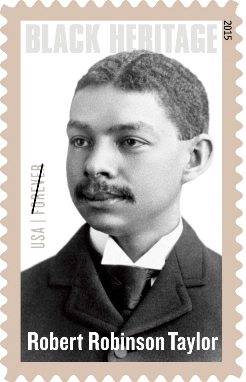
First African-American MIT Graduate, Black Architect, Immortalized on Limited Edition Forever Stamp
Robert Robinson Taylor becomes 38th Honoree into Black Heritage Stamp Series
February 12, 2015
High-resolution images of the stamp is available for media use only by emailing:mark.r.saunders@usps.gov
WASHINGTON — Robert Robinson Taylor, believed to have been both the
first African-American graduate of the Massachusetts Institute of
Technology (MIT) and the nation’s first academically trained black
architect was inducted into the Postal Service’s Black Heritage Stamp series today as the 38th honoree. His great granddaughter, White House Senior Advisor Valerie Jarrett joined Postmaster General Megan Brennan in dedicating the stamp.
The first-day-of-issuance ceremony, which took place at the
Smithsonian’s National Postal Museum, coincided with the opening of the
museum’s “Freedom Around the Corner: Black America from the Civil War to Civil Rights” exhibit.
“Anytime I face a daunting challenge and self-doubt creeps in, I
think of my great grandfather, Robert Taylor, the son of a slave, who
traveled from Wilmington, NC, to attend M.I.T. in 1888,” said Jarrett.
“He believed that with a good education, hard work, relentless
determination and a dedication to family, there were no limits to what
he could accomplish. The example he set gives me strength and courage.
My family is proud to stand on his shoulders and we know that it is our
responsibility to embrace his values, to ensure that his legacy will be
‘forever stamped’ in the conscious of future generations.”
“Robert Robinson Taylor expanded opportunities for African-Americans
in fields that had largely been closed to them,” said Brennan, who
earned her MBA from MIT. “Booker T. Washington recruited Taylor to the
Tuskegee Institute to help show the world what an all-black institution
could accomplish. Taylor designed and oversaw the construction of dozens
of new buildings built in an elegant, dignified style that befitted his
personality. But it was Tuskegee’s Chapel
that Taylor considered to be his finest achievement and masterpiece.
Washington referred to the graceful, round-arch structure as the ‘most
imposing building’ at Tuskegee. As one of our nation’s calling cards, we
hope this stamp will encourage more Americans to learn more about
Robert Robinson Taylor’s life and career.”
Joining Brennan and Jarrett in the dedication were MIT President Dr. Rafael Reif;Tuskegee University President Dr. Brian Johnson; Citizens’ Stamp Advisory Committee member Henry Louis Gates, Jr., and Smithsonian National Postal Museum Director Allen Kane.
For more than three decades, Taylor (1868–1942) supervised the design
and construction of the Tuskegee Institute in Alabama while also
overseeing the school’s programs in industrial education and the
building trades. Through his calm leadership and quiet dignity, he
earned the admiration of colleagues and students alike while expanding
opportunities for African-Americans in fields that had largely been
closed to them. Son of a Former Slave
Taylor was born June 6,
1868, in Wilmington, NC. His father was a former slave who had become a
successful carpenter, contractor and merchant. From his father, Taylor
learned carpentry and construction. After graduating from secondary
school, he worked as a construction foreman before moving to Boston in
1888 to study in the architecture program at MIT.
Taylor’s studies were rigorous. He typically spent seven hours in
class per day, and by his second year was taking as many as 10 courses
per semester in such wide-ranging subjects as mechanics, acoustics,
structural geology, heating, ventilation and sanitation, as well as in
drawing, history, English and French. He earned honors in trigonometry,
architectural history, differential calculus and applied mechanics, and
was always at or near the top of his class.
Upon graduating, Taylor had several offers for teaching jobs,
including an invitation from educator and activist Booker T. Washington
to work at the Tuskegee Normal and Industrial Institute in Tuskegee, AL.
Washington had founded the school in 1881 not only to help
African-Americans acquire valuable practical skills, but also to show
the world what an all-black institution could accomplish. Developed Tuskegee’s Architectural Curriculum
When
Taylor arrived at Tuskegee in 1892, he was both a beginning architect
and a busy teacher of architectural and mechanical drawing to students
in all industrial trades, including building construction. Before the
decade was over, he had established a beginning architecture curriculum
that included carpentry, cost estimation, training in drawing building
plans and the study of construction problems. Tuskegee soon began
offering a certificate in architectural drawing, which would help
graduates enter collegiate architecture programs or win entry-level
positions in architectural offices. Taylor’s efforts furthered
Washington’s dream of producing not just African-American builders and
carpenters, but designers and architects who planned the buildings as
well. Designer of Tuskegee’s Campus
At the same time,
Taylor set about designing and building the Tuskegee campus. Upon his
arrival, the school was an assortment of cottages, cabins, and simple
wood-frame or brick buildings scattered across an abandoned plantation.
In the years following, Taylor designed and oversaw the construction of
dozens of new, state-of-the-art buildings, from libraries and
dormitories to lecture halls, faculty housing, gymnasia, scientific and
agricultural facilities, industrial workshops, a hospital — and, most
memorably, a handsome chapel that was used for conferences, graduation
ceremonies, and religious services.
Taylor’s Colonial-style designs, including half a dozen buildings
with grand porticos and large classical columns, were built of richly
textured, multihued bricks made by the students themselves. In keeping
with Washington’s belief that well-designed community buildings proved
and nurtured racial progress, Taylor typically built in a style that was
also consistent with his own personality: elegant, dignified and
persuasive without being showy.
Taylor left Tuskegee in 1899 to work and study new building methods
in Cleveland, but continued to design buildings for the school. When he
returned in 1902, he was given the title he held for the rest of his
career: Director of Mechanical Industries. He continued to design new
buildings and oversaw the Department of Mechanical Industries, which
included 22 divisions that trained harness makers, tinsmiths,
wheelwrights, tailors, plumbers, steamfitters and many other skilled
artisans. His Inspirational Words
A 1915 letter captures
the calm determination that surely inspired students under Taylor’s
care. “There are not a great many colored architects and engineers in
the country — comparatively few — but the number is increasing and I am
glad to say that because of their work they have gradually gained the
confidence of the public,” Taylor wrote. “I realize that in any movement
which borders on that of the pioneer, that it takes some courage and
some determination, but I believe that any risk which we may take in any
operation, in any business or in any occupation, we will be fully
repaid when we see that more and more avenues are being opened up for
colored young men and colored young women, and the best lesson that we
can give them is to let them see the things which have actually been
accomplished by colored men and by colored women. I believe this would
be among the greatest contributions that we can make towards racial
progress.” Unfaltering Leadership
Later in his career,
Taylor played such a major role at Tuskegee that he served as acting
principal when the principal was traveling. When members of the Ku Klux
Klan paraded on a public road through the campus in 1923, Taylor kept
the peace. He allowed a student dance to proceed as scheduled, assured
the press that the institute could handle any trouble, and calmly
watched from his veranda as the parade passed. He soon earned a
promotion to vice principal for his strong, dignified display of
leadership — but continued to serve as Director of Mechanical
Industries.
Later in his career, Taylor designed or co-designed buildings beyond
the Tuskegee campus as well, including a combined classroom, chapel and
administrative building at Selma University; a combination office,
entertainment, and retail building in Birmingham, and elegant libraries
in North Carolina and Texas. In 1929, presented with a particularly
interesting opportunity, he traveled to Liberia to help establish the
Booker T. Washington Agricultural and Industrial Institute. He helped
organize the curriculum and advised on staffing, leadership, and
facilities, serving as an intermediary between missionaries, businesses,
and the Liberian government; he also designed plans for the campus and
its first structures. The trip was covered by the African-American
press, and Lincoln University in Pennsylvania awarded him an honorary
doctorate for his work. Public Service and Advocacy Following Retirement
After
retiring in 1932, Taylor returned to Wilmington, NC, and spent the
final decade of his life engaged in quiet but determined public service
and advocacy. He promoted a federal homesteading project for
African-American farmers and argued in favor of federally funded
African-American recreation projects. He was elected vice chairman of
the Wilmington Inter-Racial Commission, served on the board of
Fayetteville State Teacher’s College, and wrote to the U.S. Civil
Service Commission in 1941 to protest discrimination against African
Americans in the defense industry. Final Moments Surrounded by his Masterpiece
Taylor
died Dec. 13, 1942, at the age of 74 after collapsing in a chapel
during a visit to Tuskegee. According to family, moments before an
aneurism struck Taylor, the famously modest man who rarely talked about
his work acknowledged that the chapel was his masterpiece.
In her 2012 book about Taylor and Tuskegee, architectural historian
Ellen Weiss writes that Taylor was eulogized for “his principled
character, his organizational abilities, his special tact on interracial
matters, and his achievements as an educator and architect.” Colleagues
and friends recalled him as eloquent, intelligent, dignified and kind. MIT’s Influence
In a talk he gave on the occasion
of MIT’s 50th anniversary in 1911, Taylor summarized what his MIT
training helped bring to Tuskegee. In the process, he encapsulated both
his personal strengths and his lasting legacy: “the love of doing things
correctly, of putting logical ways of thinking into the humblest task,
of studying surrounding conditions, of soil, of climate, of materials
and of using them to the best advantage in contributing to build up the
immediate community in which the persons live, and in this way
increasing the power and grandeur of the nation.”
from US PO website
Mr. Taylor we thank you and we honor you.
To those who have a dream, always remember, "Yes, you can."
Martin, when I think of you,
I think of how you courageously stood tall
Fighting for us all.
Your ability to envision the world as it should be
reshaped our history.
You placed yourself in harms way
So we could enjoy the freedoms we have today.
We are thankful for your faith, your conviction,
and your continued belief that one day, we'd be free
Free, from the chains of adversity.
While we have come a long a way,
it is evident that, for some, the struggle
for freedom is never done.
It will never be over until we learn to live as one.
It will never be over if one man's dream is shattered.
It will never be over as long as we have need to remind
our country that black lives matter.
It will never be over until we, as a nation,
can lift the rug of injustice and sweep away
the dirt that has remained hidden for years.
It will never be over as long as we hesitate to
acknowledge our doubts and our fears.
It will never be over as long as we allow
a President to be blatantly disrespected to his face.
It will never be over as long as one American feels displaced.
It will never be over as long as one man's dream is deferred
by boundaries another has imposed, and the doors of opportunity
are systematically closed.
It will never be over as long as this country
continues to rob the poor man and line the
pockets of the wealthy.
It will never be over as long as any man
is denied the medical care he needs to remain healthy.
It will never be over as long as one person
is harmed by terrorists, extremists and supremacists,
annihilators and haters killing the innocent anywhere.
It will never be over as long as there is injustice anywhere.
It will never be over until black and brown boys and girls are
provided adequate tools with which to learn.
It will never be over until, in this nation,
there is equity in money earned.
The work will never be over,
and America will never be the America of our dreams
until we finally understand what freedom and justice for ALL
really means.
It will never be over until every man can live not only freely
and equally, but safely in this world.
It will never be over.
No, it will never be over.